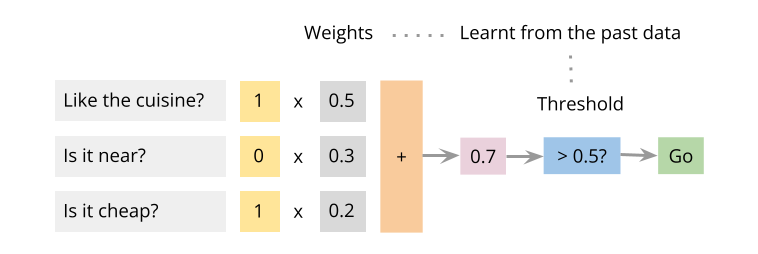
The perceptron is the simplest neural net. It operates in four steps: (1) take in several binary inputs (2) multiply each with a weight (3) add them all (4) check if it is above a threshold. If it is above, the output is 1, else the output is 0. Here is an example. Imagine you’re trying to decide whether to go to a restaurant or not. You consider several factors:
- Do you like the cuisine? (1=Yes, 0=No)
- Is it near? (1=Yes, 0=No)
- Is it cheap? (1=Yes, 0=No)
Each of these factors has a different level of importance to you. For example, maybe you really care about the cuisine, but you don’t care as much about the distance or the price. So you could assign more weight to the factors you care about. You could represent these weights as
- Cuisine: 0.5
- Near: 0.3
- Cheap: 0.2
These weights represent how important each factor is in your decision-making process. The perceptron works by multiplying each factor (input) by its weight, then adding up these weighted inputs. If the total exceeds a certain threshold (let’s say 0.5 in this case), you decide to go to the restaurant; if not, you stay home.
In machine learning, a perceptron can start with random weights, and learns the correct weights and the threshold based on the data it’s trained on.
 Ananth K.